Value
Story is found in the conflict between two opposing values. The axis between them is the dimension where the story takes place. A story has one axis, and every character is measured along it — faith versus doubt, for example.
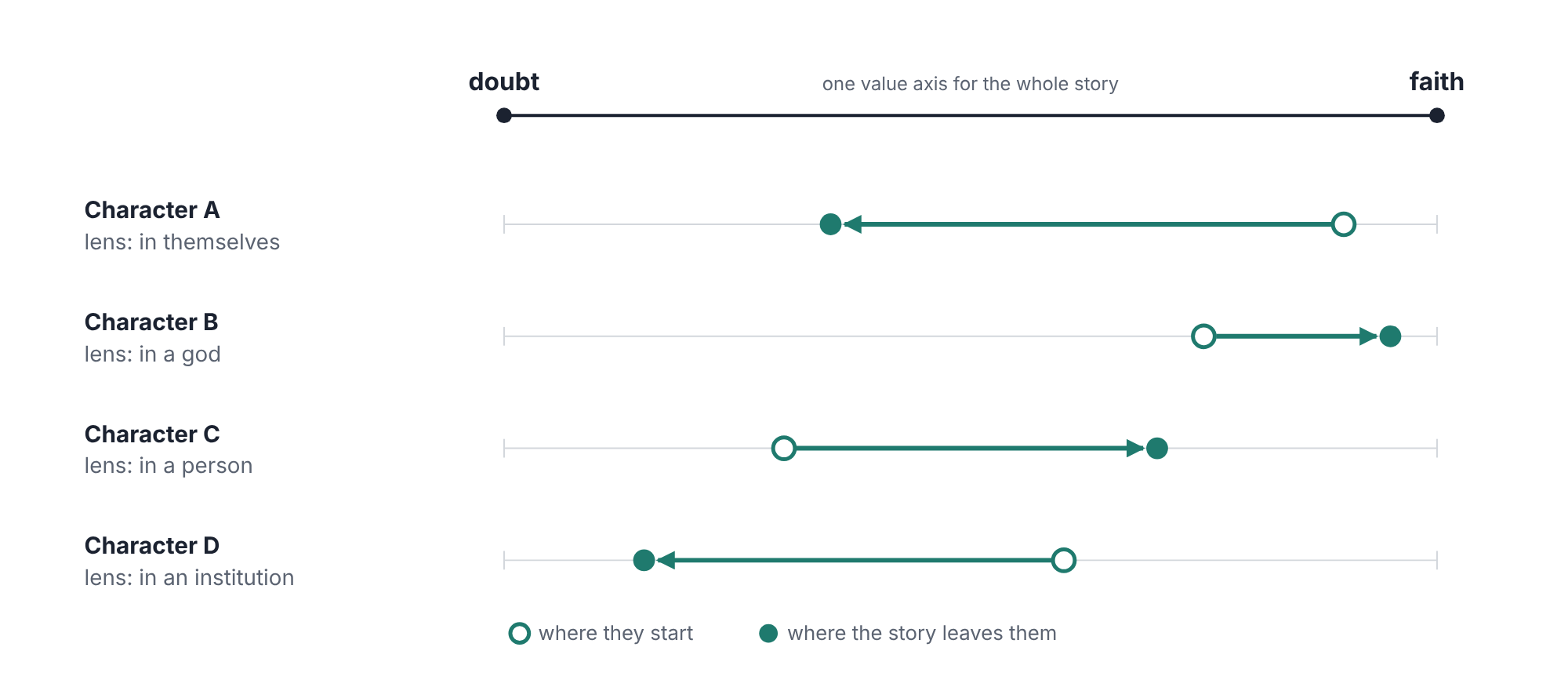
Neither pole is simply good
Values are relative. A virtue often lies in the tension between two vices — on faith versus doubt, blind faith fails as surely as consuming doubt. A character can fall toward either pole.
The lens
Each character holds the value through their own subject: the thing the value is held toward. On faith versus doubt, that might be faith in themselves, in a god, in a person, in an institution. The axis stays the same; the lens changes. Two characters can stand at the same point on the axis and hold the value toward entirely different things.
Belief
A belief is a character's position on the axis, through their lens, stated as the claim they would actually make.
The belief is an assertion — a hypothesis. The sequence (catalyst → crisis → climax) is the experiment, and the resolution is the raw result — a fact, which will be interpreted by the character. Can they reconcile their belief with the fact of the resolution?
The crisis can reveal the belief. If each road honors one side of what the character values, the choice shows where they stand. Their belief at the movement's first line is wherever they would have to start for that choice to cost them.
The objective expresses the value
The objective is the character's own expression of what they value, through their lens — and it can be wrong. When it is, the plot line and the value line part. See Story Shape.
Theme
The cast holds one value through several lenses at once. The theme is what happens to each lens: which survive the test, which break, and what that says about the value.
Across the tree
A child's belief is one of the things the parent's belief stands on: either something the parent's claim requires in order to hold, or part of the experience a broader conviction was built from. A belief that restates its parent in different words means that level has not earned itself.
Each sibling tests a different leg of the parent's belief. Testing the same leg twice is a sagging middle — the second costs nothing, because the reader already watched that one get tried.
Template
**[Character]**
- Lens: <!-- the subject they hold the value toward -->
- Position: <!-- where they stand on the axis, as the claim they would make -->