Story Assembly
Story Engine says what a movement is. This says how movements are assembled into a story.
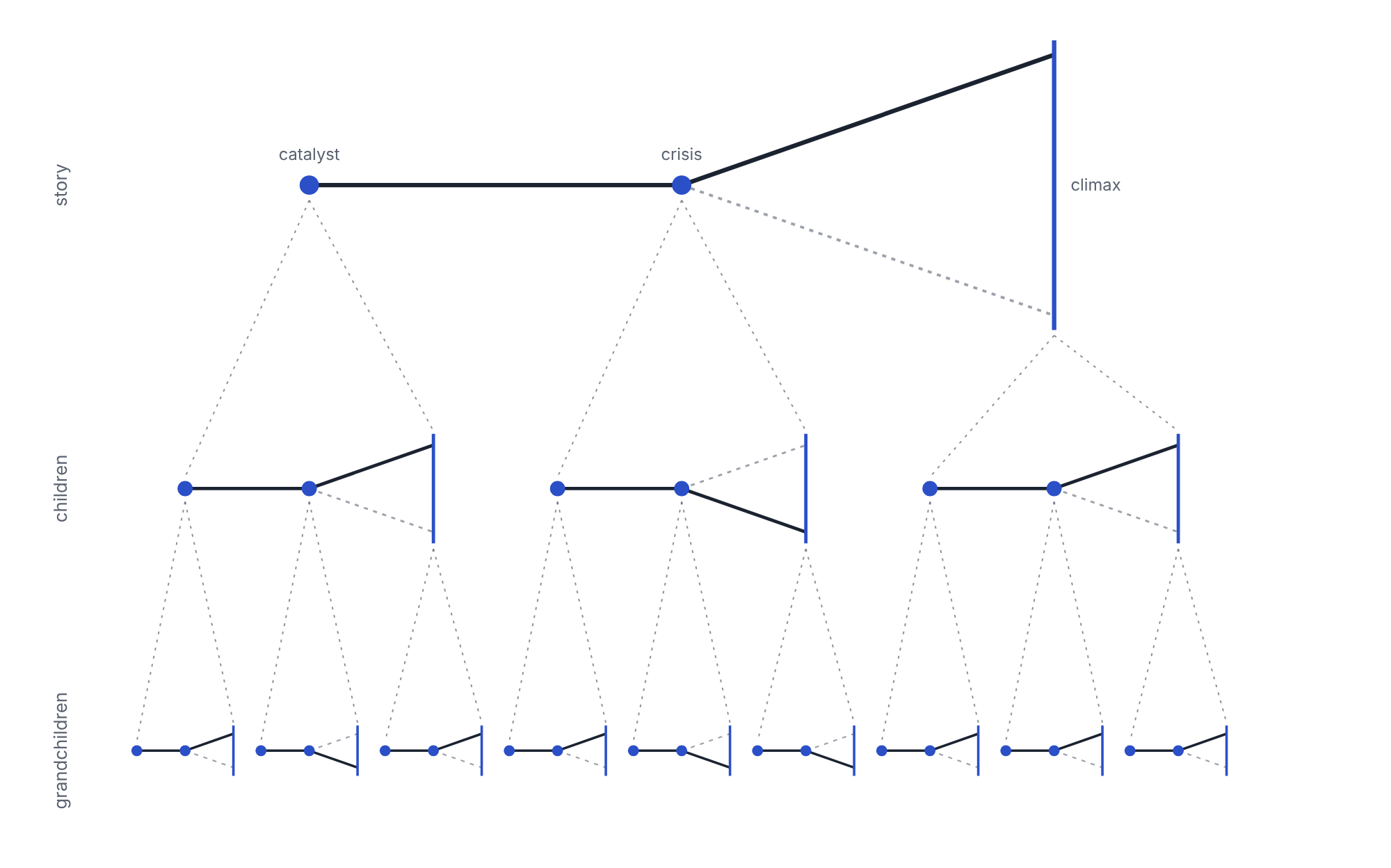
The tree
A story is a tree of movements. Every node is a movement, the same engine worked as the same seven parts — the book and the series included.
The catalyst, crisis and climax expand, each into a child of its own. Objective, stakes and cost don't; the catalyst sets them, and they hold across all three children.
The second and third children pursue the parent's objective, each in a specific form. The first need not: the parent's objective doesn't exist until that child ends, so its objective can be what the character wanted before it.
So a movement has three children, one under each of those parts. Expand until the turn can be expressed on the page.
Depth is therefore uneven. One catalyst may be given justice by a single scene while its sibling crisis needs three. Magnitude names a movement's size, not its depth in the tree.
What a child hands up
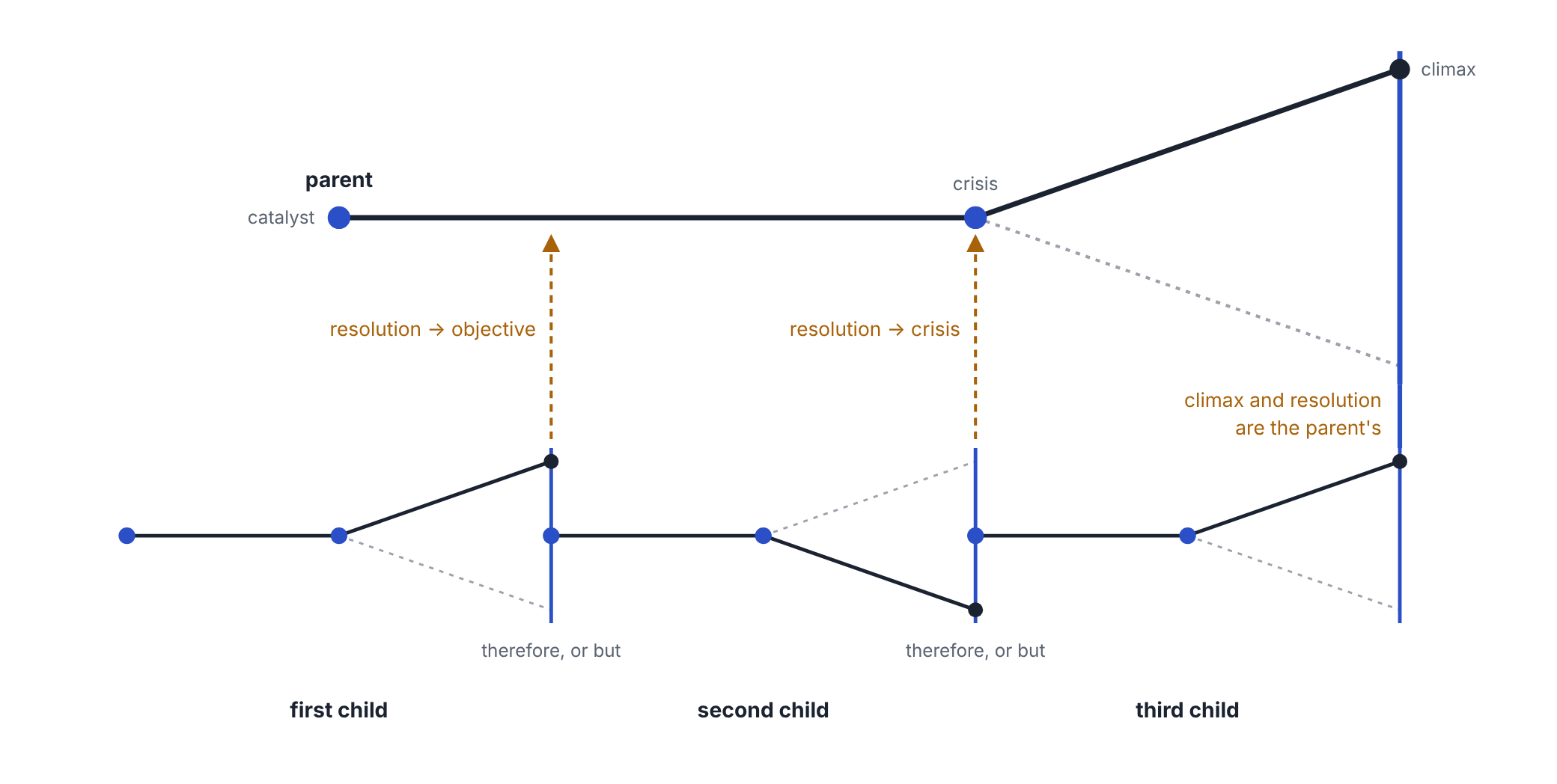
- the first child's resolution gives the parent its objective. The parent's catalyst falls somewhere inside it's first child, at its opening or as what it builds to.
- the second child's resolution is the parent's crisis
- the third child's climax and resolution are the parent's
The asymmetry is forced by the definitions. A resolution is a fact; a climax is chosen. Nothing's resolution can hand a parent its climax, because no fact hands a character a decision.
The last child therefore ends where its parent ends — the same ending at two magnitudes. It is pinned at two points where its siblings are pinned at one, and it cannot be worked independently of its parent.
The pin is per character. Three pins between a movement and its final child, not one.
Where the parent's catalyst lands
Anywhere inside the first child: at its opening, when the movement opens on something already in hand (the previous sibling's resolution), or as what it builds to. Either way the first child ends when the character holds the objective. Both cases can run side by side in one sheet, for different characters.
When the catalyst has to be built to, a parent does not properly begin until partway through itself. The spans are flush at both ends; only the parts are offset.
Shared catalyst
Every character in a movement shares one catalyst: the collision where their paths meet. Each character's catalyst names that event from their own side.
Siblings
A child's resolution either is the next sibling's catalyst — the world's answer forces the next reaction — or it sets a new status quo that the next sibling's catalyst disrupts. Either way the next catalyst follows from it: therefore, or but — never and then.
Magnitude
A parent's stakes can never be smaller than its child's. It is the same statue at every level, and the larger cut cannot remove less stone.
Other assemblies
The fractal isn't the only way to assemble movements. Accumulation, where movements sit side by side and nothing hands up, and juxtaposition, where placement recasts what came before, are two others, and there are likely more. They aren't worked out here.