Story Engine
The engine
Something happens and the character has to make a hard choice that will leave them somewhere other than where they started.
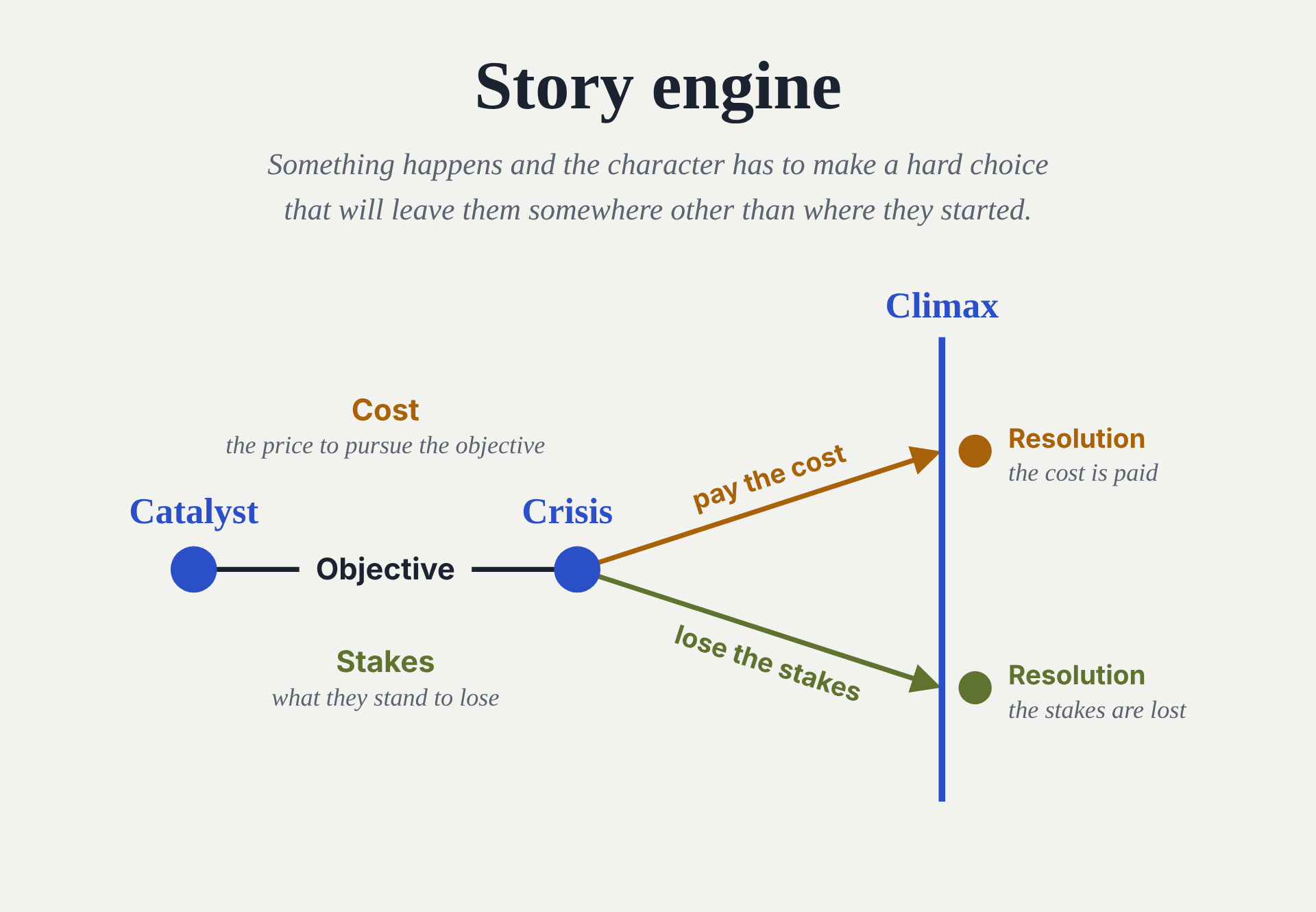
The catalyst creates two things: the objective — what they now want in response — and the stakes — what they lose if they fail to get it. Pursuing the objective carries its own price — the cost. Stakes and cost are two sides of one coin. Both are facts, but their worth is weighed on the character's own scale.
The story tightens the gap between them until the character reaches the crisis: a fork in the road. Pay the cost, or lose the stakes. The climax is the step onto one road — chosen and irreversible. The resolution is the price, collected. What the price means to the character is the value line's business — see Value.
A movement is one turn of the engine, at any magnitude — a beat, a scene, an arc, an act, a book, a series.
If neither road costs anything, it is not a movement — and it has not earned its place on the page.
The parts of a movement
Every movement turns on three points: catalyst, crisis, climax. The other parts are built on them.
1. Catalyst — disrupts the status quo
An external event that forces a reaction. It creates the objective and the stakes that follow — if the protagonist does nothing, they lose something tangible.
2. Objective — what the protagonist immediately wants
Specific and demonstrable. The goal the protagonist pursues in reaction to the catalyst.
3. Stakes — what they stand to lose
Make it personal — world-scale stakes are inert until they convert into a specific loss for the specific person choosing.
Establish it early — tension is the reader doing the arithmetic ahead of the character, and stakes revealed at the crisis arrive too late.
Close the alternatives — any unclosed option deflates stakes to nothing. If the problem could be solved another way tomorrow, there are no stakes today.
A fact, not a belief — a belief can be argued back out of.
4. Cost — the price to pursue the objective
External and visible. They will be willing to pay it until it exceeds the loss of what is at stake.
what they'd readily pay < cost < stakes
5. Crisis — pay the cost or lose the stakes
Best-bad-choice, or irreconcilable goods. Write out both roads and their consequences before choosing. If one is obviously right, the crisis isn't built yet.
6. Climax — the action taken from the crisis decision
This part is theirs: irreversible, and chosen. It commits them to one price. What happens next isn't theirs.
7. Resolution — the price, collected, and the new status quo
The cost is paid, or the stakes are lost. The result is how the world answers their decision — a fact, not theirs to author, but theirs to interpret. It leaves them somewhere other than where they started.
Template
---
magnitude: [beat / scene / arc / act / book / series]
---

# [Name]

### 1. Catalyst
<!-- Forces a reaction; creates the objective and stakes that follow.
     One line per character when tracking more than one. -->
- **[Character]**:

### 2. Objective
<!-- Specific and demonstrable. -->
- **[Character]**:

### 3. Stakes
<!-- Personal. Established early. Alternatives closed. A fact, not a belief. -->
- **[Character]**:

### 4. Cost
<!-- readily-paid < cost < stakes -->
- **[Character]**:

### 5. Crisis
<!-- If one road is obviously right, it isn't built yet. -->
- **[Character]**
  - _Pay the cost:_
  - _Lose the stakes:_

### 6. Climax
<!-- Theirs: irreversible, chosen. Commits them to one price. -->
- **[Character]**:

### 7. Resolution
<!-- The price, collected. A fact, not theirs to author, but theirs to interpret. -->
- **[Character]**: